Compressed Modernity and Institutional Lag: The Making of China’s Youth Career Predicament—The Case of Clinical Medical Education and Residency Training
Medicine & Society · Institutional history and young workers
Hospitals need their night shifts. Universities need their degrees completed. Pay, rest and an independent life can apparently wait. Those who impose the waiting must account for its cost.
Jia-Hao (Jay) Ji · 9 September 2026
In March 2024, Li Li, a student in a clinical professional master’s programme, was assigned six night shifts. Two fell on weekends. None came with compensatory time off. Alongside that rota stood a monthly allowance of 1,500 yuan and errands collecting parcels and takeaway meals for her supervisor. When she objected to the schedule, her objection was rejected. Red Star News recorded these experiences in an interview that month.1
Published accounts from teaching hospitals repeatedly describe a familiar encounter. A young trainee tries to discuss exhaustion, rest or dignity at work. The reply turns immediately to the length of medical training and the duty to serve. A question about scheduling becomes a defect of character. A failure of management acquires the moral prestige of professional formation.111
Once “training” becomes a permit to command young people’s time without paying for it, education becomes a cover for cheap labour.
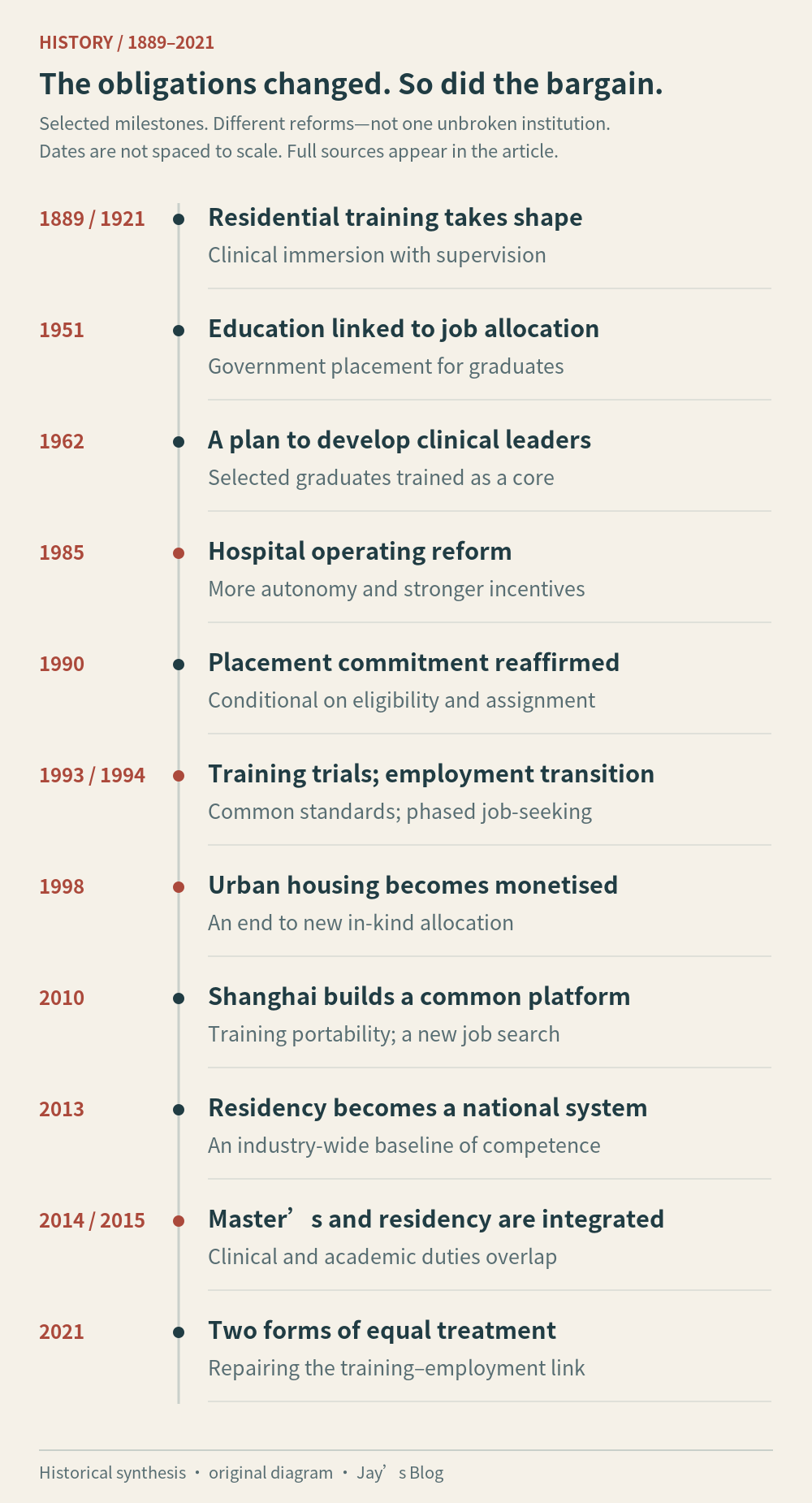
This predicament has a history. Residential medical training, state allocation of graduates, hospital financial reform, housing markets and the integration of degrees with residency have accumulated across different decades. Their demands now share the calendar of a medical student in their twenties. To understand the pressure on that student, we have to follow how these arrangements were built and passed down.3101216

The support that disappeared, and the tradition that survived
In one important source of modern residency training, residents actually lived in the hospital.
Johns Hopkins Hospital opened in 1889. William Osler brought young doctors to the bedside, combining sustained observation with close supervision. In the 1920s, Peking Union Medical College Hospital adopted this training tradition. Resident responsibility and the chief-resident system became important parts of modern clinical education in China.23

The educational rationale was substantial. Disease changes over time. Clinical judgement develops through observation, decisions and feedback. A textbook alone cannot supply that experience. Yet celebrations of demanding training frequently omit the support that made it possible.
At PUMCH around 1950, staff cleaned residents’ and nurses’ clothes and rooms. Hot food remained available after emergency operations at night. Ma Jiarun, who began working at the hospital in 1950 and entered medical-records work, recalled these arrangements in a 2011 interview. The unglamorous details matter: round-the-clock professional training requires an expensive support system.4
A hospital that repeatedly invokes its predecessors’ constant presence while falling silent about accommodation, recovery time and teaching duties is practising a highly selective form of inheritance. It remembers exactly what it can demand from the trainee. It forgets what the institution must provide in return.

State allocation carried responsibilities of its own
After the government took over PUMCH in 1951, experienced personnel were transferred to other medical institutions, carrying clinical experience and records-management practices with them. The State Council’s 1955 directive on graduate allocation placed tens of thousands of young people within national staffing plans. This was a system that demanded obedience and decided where people would go. In urban public institutions, employment arrangements, housing allocation and medical benefits were also linked to membership of the work unit, with substantial differences in coverage and provision.4567
The same 1955 directive drew limits around employers’ power. It criticised the suppression of graduates’ reasonable opinions, the placement of some medical graduates in factories and mines without adequate professional guidance, and the unauthorised early removal of students from education for work. Seventy years ago, policymakers already recognised that a shortage of personnel did not justify unrestricted use of the young.6
“We all had to endure it” cannot survive a serious encounter with this history. The record includes obligations imposed on graduates and restraints imposed on institutions. Selecting the obedience while discarding the organisation’s responsibilities is an abuse of historical memory.

Hospital accounts and cheap “student time”
The financial arrangements changed in the 1980s. In 1985, the State Council endorsed a Ministry of Health reform report responding to shortages of services and funding. It proposed greater hospital autonomy, trials of director responsibility, fixed subsidies and retention of surpluses. Alongside public funding, hospitals paid greater attention to service revenue, costs and balances. Financial pressures entered medical management more deeply.10
This changed the calculations within clinical departments. Teaching takes resources that may not appear in the day’s output. A senior doctor who spends half an hour explaining a case does not immediately increase outpatient throughput. Hiring a clinical secretary adds an explicit staff cost. When record quality is tied to departmental performance, electronic documentation, paperwork and errands can slide towards the people least able to refuse. China Youth Daily’s 2024 reporting documented pressures around medical-record quality reaching supervisors and students alike.11
Established staff have personnel or employment relationships through which to claim benefits. Professional master’s students depend more immediately on rotation requirements and degree assessment. Fear of losing time, graduation or employment prospects becomes a resource for keeping a department’s costs down.1618
The unpaid portion of the bill does not disappear. It becomes sleep a trainee loses and money a parent continues to send. Appeals to vocation can make public institutions’ operating costs look like a young person’s private duty.
A labour market that moves on, and lives told to wait
The market reforms of the 1990s gradually separated employment and living arrangements previously joined by the work unit. The 1993 education reform programme proposed a transition from centrally assigned jobs towards graduates finding employment. The 1998 housing reform required an end to housing allocation in kind and a gradual move towards monetary arrangements. Young doctors increasingly had to rely on wages, family savings and borrowing to secure housing. More of the risk of entering employment and establishing an urban life fell on individuals.127

Changes to training could meanwhile overturn plans already made. During Shanghai’s new residency reform in 2009, China Youth Daily reported that medical student Zhao Gangde’s expected contract signing had been suspended. Other graduates described concerns about additional training and its financial terms. Three more years occupy very little space in a policy document. For someone who has already spent years studying medicine, they can rearrange marriage, income and an entire professional future.13
Standardised training has genuine public value. Too much of its cost should never be loaded onto young people in a vulnerable transition. The relatively settled employment and housing arrangements of the work-unit era have changed. The demand that an individual obey, endure and postpone an independent life remains available whenever an organisation wants another concession.
Integration on paper, collision in the body
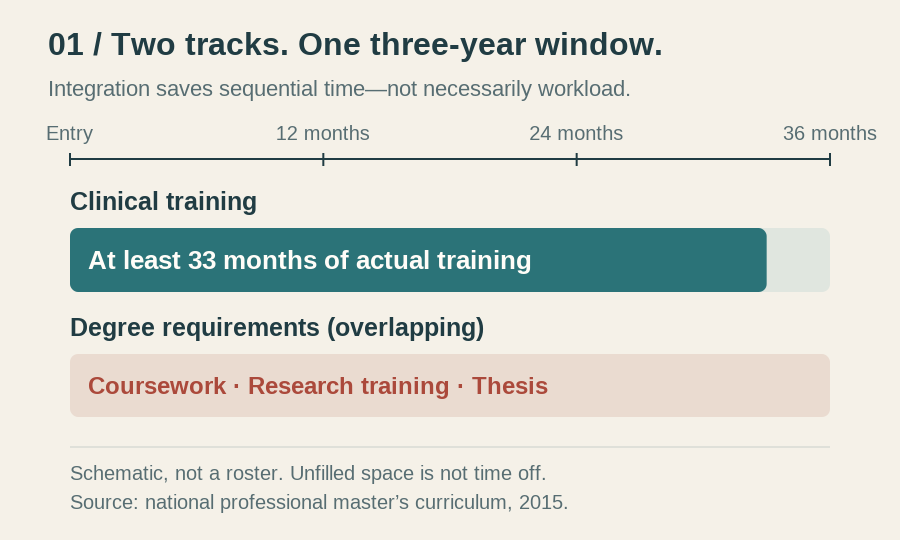
The 2014 medical-education reform brought clinical professional master’s degrees and residency training onto a shared track. The 2015 national framework required at least 33 months of actual clinical training within a three-year degree, alongside coursework, research training and a dissertation.1718
That arrangement places several identities on the same person:
- On the ward, students provide frontline clinical work and are expected to approach patients with a physician’s sense of responsibility.
- At the finance office, they are classified as enrolled students and paid under a different set of arrangements.
- In research assessment, they remain apprentices with coursework and a dissertation to complete. Where additional publication demands apply, the fragments of time after a night shift can also be consumed by the pursuit of journal metrics.11618
Integration was intended to remove duplicated training. At bases where the demands are poorly coordinated, students’ bodies fill the organisational gaps. Clinical rotations, dissertations and medical quality each have their own checklist. Every department can add another requirement. None can add a twenty-fifth hour to a trainee’s day.
How authority passes from one generation to the next
Old arrangements persist through ordinary management decisions. In 2011, Xuzhou Central Hospital’s newspaper described an arrangement requiring residents to remain on site for 12 hours and be available around the clock, citing earlier resident-responsibility rules. The account shows how the language of inherited responsibility could justify a new attendance requirement.19
Dependence on assessment can exercise even more control than long hours. Rotation evaluations, ongoing assessment and review of eligibility for completion connect daily supervision with the training base. Licensing examinations, residency completion and degree conferral have their respective authorities. Departments can still affect whether a student reaches those later stages on time.1618
Hafferty and Franks’ account of the hidden curriculum helps explain this relationship. Students learn how to survive from what an organisation rewards, punishes and leaves unchallenged, alongside the medicine it formally teaches.20
When questioning a rota is treated as immaturity, refusing a private errand raises anxiety about the next assessment, and taking sick leave threatens additional training or delayed graduation, speaking carries a price. The leave and delay experiences documented by Red Star News show how these concerns enter ordinary life.1 Silence under that dependency cannot be counted as consent.
There is also a damaging generational inheritance. Some who survive the system recast their own suffering as a compulsory part of becoming a doctor, then impose it on the next cohort. “That is how it has always been done” supplies an escape from managerial accountability. Another year passes; the opportunity to change the arrangement is lost again.
Compressed modernity and the cost of overlapping demands
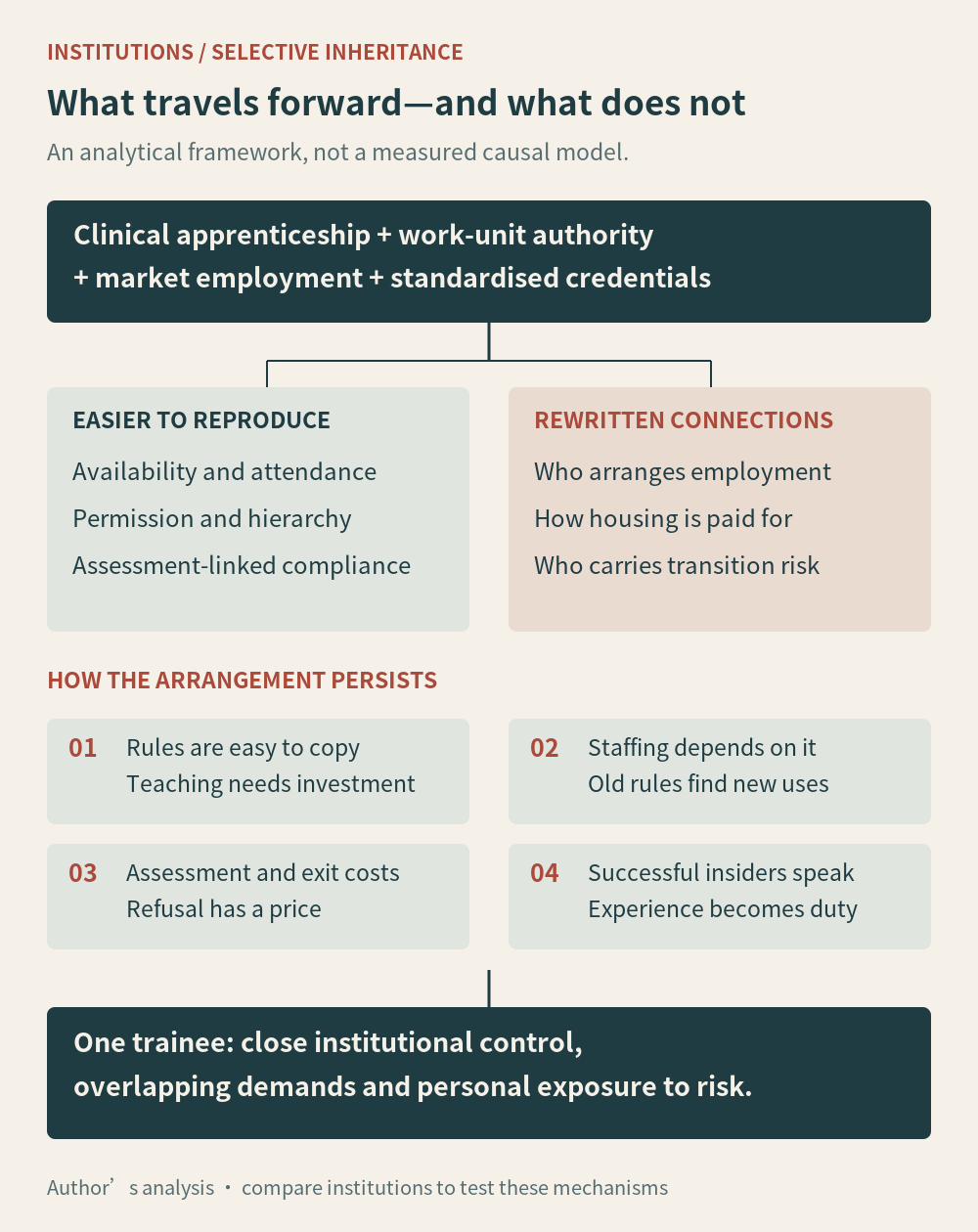
Sociologist Chang Kyung-Sup’s concept of compressed modernity offers a framework for this history: institutions and values from different periods become concentrated and recombined within contemporary life.21
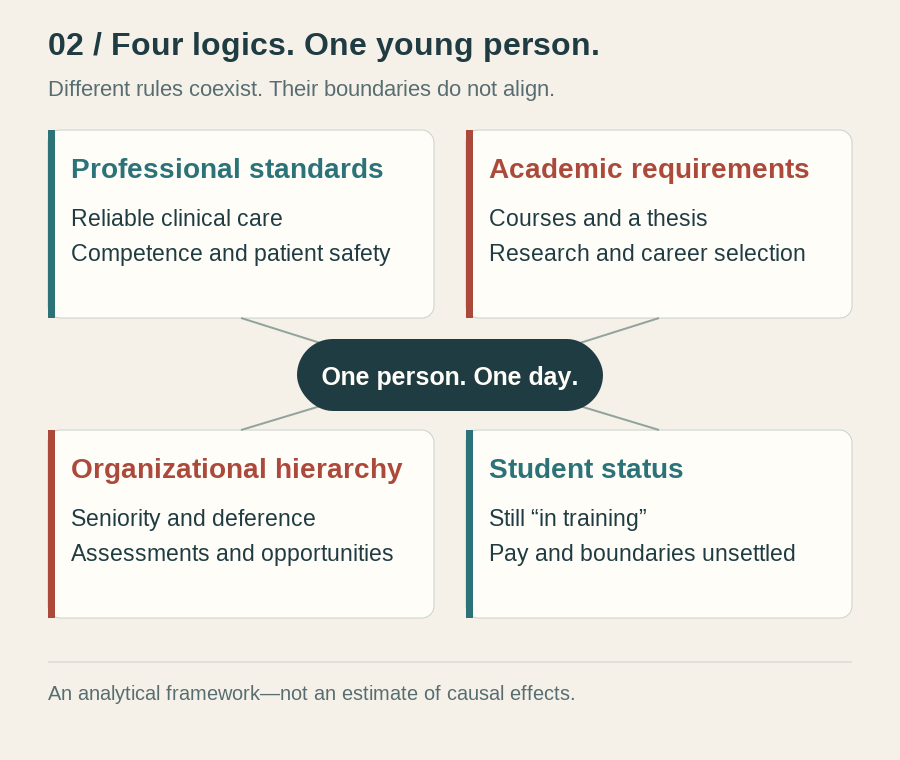
Applied to medical training, it brings several pressures into view. Apprentice-like dependency, bureaucratic discipline, the work-unit vocabulary of dedication, hospital financial targets and fierce employment competition can all converge on a single person in their twenties. Individuals must bear market risks while organisations continue to demand near-unlimited obedience.
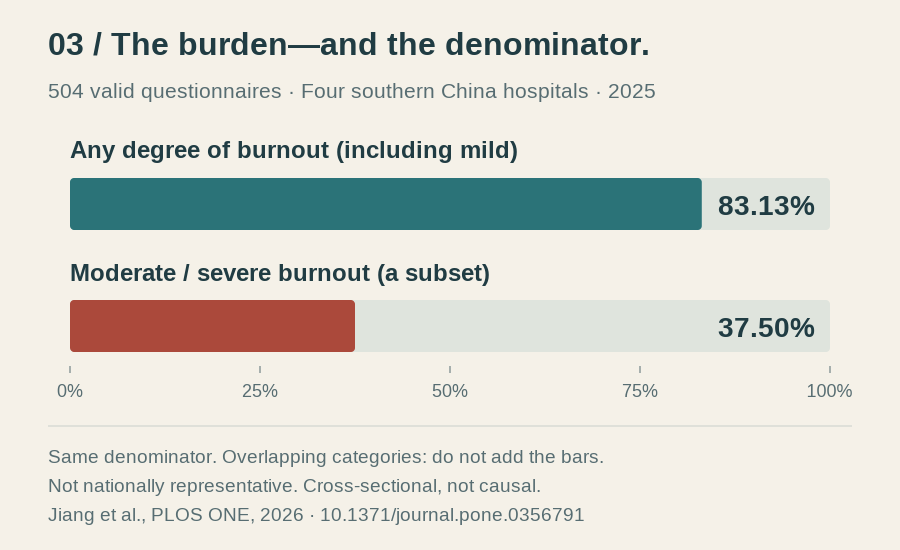
The effort–reward imbalance model concerns the gap between effort and rewards such as pay, respect and professional prospects.22 A study published in August 2026 analysed questionnaires collected in April 2025 from 504 residents in four tertiary teaching hospitals in southern China. Under its measures, 30.16% experienced effort–reward imbalance and 83.13% had some degree of burnout, including mild burnout. High-grade burnout accounted for 3.37% of the full sample. These are findings from that cohort.23
Consider a young adult who still cannot control a basic daily schedule, who has studied medicine for close to a decade and still needs money from parents, who comes off a night shift exhausted and is then asked to feel guilty about the exhaustion. Under those conditions, another lecture about resilience and dedication carries the force of emotional coercion.
Those who control the rota are responsible for making rest possible. Repeatedly directing the problem back into the trainee’s attitude evades changes management already has the power to make.
Rights need to be written down and enforced
Vague moral demands must give way to obligations that can be checked and enforced.
In 1999, the US National Labor Relations Board ruled in Boston Medical Center that the interns, residents and fellows at issue were employees within the meaning of the National Labor Relations Act while also receiving professional education.25 Their educational status did not erase the labour they provided.
In July 2003, the ACGME implemented national residency duty-hour standards, including a maximum of 80 hours per week averaged over four weeks. Its August bulletin was already discussing complaints and trainees’ fears of retaliation. Making hours an accreditation requirement created a standard against which institutional practice could be challenged.26
China also has concrete examples of change. The 2021 “two equal treatments” policy addressed recruitment and related treatment after residency completion. Shenzhen’s rules, effective from January 2024, went further into the training period: training bases should pay performance supplements according to clinical workload to enrolled professional-degree students who have obtained physician qualifications and participate in clinical work.2728
These measures undermine the excuse that student status makes recognition of work impossible. Payment, hours and responsibility can be specified. When protection keeps failing to arrive, the next questions should concern the department, budget or decision holding it back.
Hospitals must pay for the training they demand
Training the next generation of clinicians is a public undertaking. Public training funds, medical-education spending and teaching-hospital budgets should share its costs. Quietly covering the shortfall with young people’s lost sleep, inadequate allowances and continuing family transfers is institutional exploitation of those with the least bargaining power.
Four changes deserve explicit commitments.
- Open the accounts. Show how residency funds are distributed, how much reaches trainees, and how much pays for supervision and other costs.
- Make hours and recovery enforceable. Set limits on continuous work, require recovery after night duty and stop using “availability” to conceal continuous attendance.
- Return duties to education and clinical work. Eliminate private errands such as collecting supervisors’ food and parcels. Keep students’ clerical workload within a defensible educational balance.
- Separate complaints from direct assessment. Provide independent review and a route for raising concerns outside the supervisory relationship in which retaliation is feared.
These are reform demands. Students’ clinical duties must also match their qualifications, competence and supervision. A staffing shortage does not cancel the hospital’s teaching responsibilities.24
Return to Li Li. Adequate recovery after those six night shifts requires changes to the rota and staffing. The meals and parcels should be collected by the people who ordered them. Managers can start by fulfilling the basic responsibilities already within their control.
Medical education teaches young doctors to take responsibility for patients’ lives. Its managers must also take responsibility for the young people whose work they use. Those exhausted in hospital corridors through the night have supplied enough patience. It is time for the people holding the budgets, rotas and assessment forms to answer for their decisions—and change them.
Based on public historical documents, published interviews and research. Personal experiences follow the cited reports. The 2011 hospital account describes its own period, not present-day scheduling. The final recommendations are proposals for reform.
Sources and further reading
[1] Cai Xiaoyi, Zhou Song and Yu Xindu. 陷在“规培证”里的专硕医学生:有的请假超15天就会被延毕. Red Star News, republished by CCTV, 23 March 2024. Chinese reporting.
[2] Johns Hopkins Medicine. Osler Medical Residency — Philosophy and History. Institutional history.
[3] National Health and Family Planning Commission. Summary of the 2014 report on the development of standardised residency training in China. 2015; republished by the Hubei health authority.
[4] Luo Xuehui. 从老协和到新协和. Published interview with Ma Jiarun, republished by PUMCH, 28 September 2011; recollections of the hospital around 1950.
[5] PUMCH. 新中国70年:北京协和医院20个历史瞬间. 14 October 2019. Institutional history.
[6] State Council. Directive on the coordinated allocation of higher-education graduates in summer 1955. 9 August 1955; reproduced historical text.
[7] State Council. Notice on deepening urban housing reform and accelerating housing construction. State Council Document 23 of 1998, 3 July 1998; Beijing government republication.
[8] PUMCH. 周玉淑:开拓中国急诊医学事业的巾帼女将. 5 November 2025. Further reading: recollections of training beginning in 1964.
[9] Ministry of Health, Ministry of Finance and State Labour Administration. Supplementary notice on pilot hospital economic management. 5 November 1979. Further historical background.
[10] State Council and Ministry of Health. Notice endorsing the report on policy questions in health-sector reform. State Council Document 62 of 1985, 25 April 1985; reproduced historical text.
[11] Wu Xinyu and Xie Yang. 规培生从医之路 如何走得更好更顺. China Youth Daily, 16 April 2024.
[12] CPC Central Committee and State Council. Outline for educational reform and development in China. 13 February 1993; Shanghai education authority republication.
[13] Bai Xue. 上海住院医师培养制度引发争议. China Youth Daily, 10 December 2009.
[14] Ministry of Health. Notice implementing trial measures for standardised clinical residency training. 17 February 1993; hospital republication in 2013. Further reading.
[15] Children’s Hospital of Fudan University. Resident personnel-management measures. 22 August 2013, citing Shanghai’s 2010 rules. Further reading on training contracts and subsequent employment.
[16] National Health and Family Planning Commission and six other agencies. Guiding opinions on establishing standardised residency training. Document 56 of 2013, 31 December 2013.
[17] Ministry of Education and five other agencies. Opinions on medical-education coordination and clinical training reform. Document 2 of 2014.
[18] State Council Academic Degrees Committee. Guidance framework for the professional master’s degree in clinical medicine. 29 May 2015; CHSI republication.
[19] Liu Dayue. 住院医师规范化培训全省交流. Xuzhou Central Hospital, New Health, 15 December 2011.
[20] Hafferty FW, Franks R. The hidden curriculum, ethics teaching, and the structure of medical education. Academic Medicine. 1994;69(11):861–871.
[21] Chang K-S. The second modern condition? Compressed modernity as internalized reflexive cosmopolitization. British Journal of Sociology. 2010;61(3):444–464.
[22] Siegrist J. Adverse health effects of high-effort/low-reward conditions. Journal of Occupational Health Psychology. 1996;1(1):27–41.
[23] Jiang Y, et al. How do young chinese physicians cope with stress under standardized training? Investigating perceived stress, depression, and their interrelationships. PLOS ONE. 2026;21(8):e0356791. Published 24 August 2026; 504 questionnaires from four hospitals, collected in April 2025.
[24] Ministry of Health and Ministry of Education. Interim rules for clinical practice in medical education. 18 August 2008; Jinzhou Medical University republication.
[25] National Labor Relations Board. Boston Medical Center Corp., 330 NLRB 152. 26 November 1999. Decision facsimile; within the statutory scope of the US NLRA.
[26] Miller M. ACGME Receives the First Complaints Related to New Duty Hour Standards. ACGME Bulletin, August 2003, p.7.
[27] National Health Commission. Explanation of the “two equal treatments” policy for residency graduates. 8 September 2021.
[28] Shenzhen Municipal Health Commission and other agencies. Shenzhen measures for standardised residency training. Document 5 of 2023; effective 1 January 2024.
Text: Jia-Hao (Jay) Ji. Original SVG illustrations by this blog. Photograph credits and licences appear in the captions.